
It has been a bad week for American computer systems. Between Friday and Monday, air traffic control, a major airline, large banks, Microsoft’s office services and a payroll provider each suffered a significant outage. Online, some people have called it the start of something bigger. The official explanations so far point to ordinary technical faults, though they are unsettling enough on their own.
The air traffic stoppage
On Friday 13 November, at about 3:30 p.m. Eastern time, the Federal Aviation Administration ordered a nationwide ground stop. It lasted about four hours and 45 minutes, and flights resumed at 8:15 p.m. The FAA says about 3,500 aircraft already in the air landed safely, and operators cancelled roughly 12,462 flights, including 9,082 by major airlines, though it adds that not every cancellation was a direct result of the stop.
The FAA’s own account blames its ageing communications network. Legacy equipment became unstable when it was flooded with data, at a rate of about 1,000 connection attempts every four to five seconds. The first investigation points to a radar site in Amarillo, Texas, and a radio site in El Dorado, Arkansas, where a contractor, L3Harris, had been working, including installing a new router. The instability spread to 17 of the 22 en-route control centres. The FAA says it has “no indication that this was a cyberattack or an outside nefarious actor”, has disabled a feature on the routers involved and on more than 60 others, and has paused further installations.
The other failures
- Microsoft 365: a global outage knocked out Outlook and other services late last week. Microsoft said it was fixed by Saturday, and one security specialist blamed a cascade from weekly server updates.
- Workday: the workplace-software provider had an outage on Friday, which it traced to its disaster-recovery system.
- Banks: on Monday, customers of Chase, Bank of America, Wells Fargo and U.S. Bank reported trouble getting into online services. JPMorgan Chase said a software bug was delaying some transactions.
- United Airlines: on Monday afternoon the airline reported a “widespread system outage” that held up departures, and said it was resolved later that day. No cause was given.
Connected or coincidence?
Experts quoted in news coverage say there is no evidence that the incidents are linked. They involve different companies, systems and stated causes. Some prophecy and commentary sites have gone further, describing the run of failures as a rehearsal for a larger event or linking it to rumours of an impending blackout, and some have suggested artificial intelligence or hostile action may be behind it. We have not found evidence for those claims in the official statements, and we are not repeating them as fact.
Why it matters
Whatever the causes, the week showed how much daily life depends on a small number of shared systems, some of them old. The air traffic network that failed is a legacy system that the FAA is in the process of replacing. We looked at the extreme end of this risk in our explainer on a long power failure, What is a “black sky” event?, and the practical advice there, such as keeping some cash, water and a way to contact family, applies equally to a bad day for the banks or the airlines.
A word from Scripture
“The prudent see danger and take refuge” (Proverbs 22:3), and “do not be anxious about tomorrow” (Matthew 6:34). A week of outages is a reasonable prompt to be sensibly prepared, without panic.
Reporting note: The air traffic figures and cause come from the FAA’s published questions and answers. The other outages come from a Chicago television station’s summary of news reports. Cancellation totals include flights not directly caused by the ground stop, and investigations are continuing.
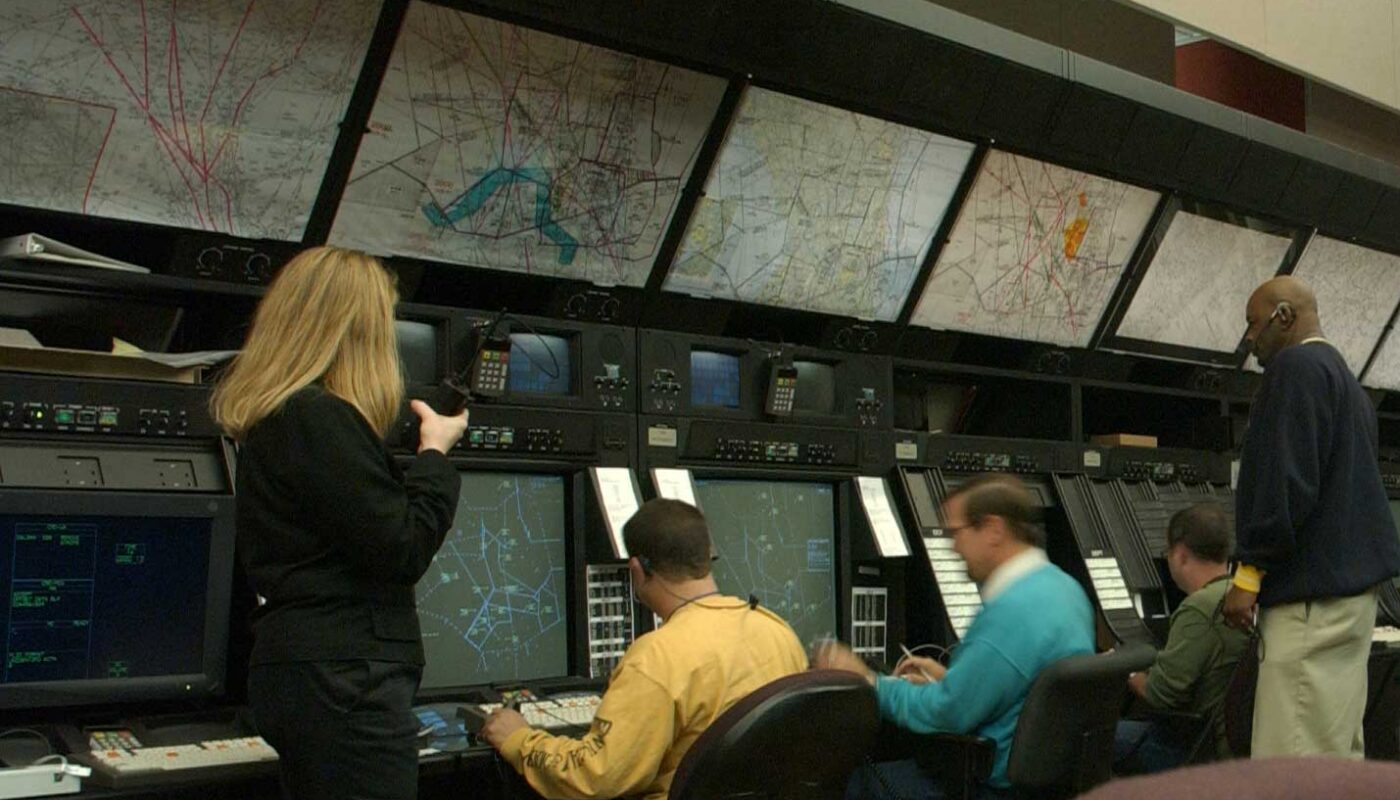
Photo: Work of the United States Federal Government under the terms of 17 U.S.C. § 105 / Public domain / Wikimedia Commons. Controllers at an FAA air route traffic control center; an archive photo, not from this week.